Most nonprofits, think tanks and public bodies already use AI, but few have adopted it as institutions. The gap comes down to willingness and security more than regulation.
AI has already reached NGOs, think tanks and government offices. Much like early AI adoption in the for-profit world, it arrived through individual staff rather than through the institutions they work for.
Three-quarters of humanitarian workers now use AI daily or weekly, yet fewer than a quarter of their organizations have a formal AI policy (Humanitarian Leadership Academy). The gap with large companies is not one of use. It is one of institutional adoption: budgets, policies, workflows and scale.
This report asks what is holding that official adoption back. Is the hurdle regulatory, legal, cultural or psychological? And can the market, or the organizations themselves, solve it?
The evidence across six regions points in several directions. Outside Europe, regulation is rarely the binding constraint. Even inside it, the EU has delayed its own high-risk rules to December 2027, and Singapore's agentic AI framework is voluntary.
The everyday barriers are capacity and culture. There is often no money set aside for AI, thin skills at leadership level, policies that are missing or that actively discourage staff from using AI, and a gap in conviction between executives and frontline staff. In European NGOs and think tanks especially, that lack of funding reflects the wider psychological and cultural caution that has slowed AI adoption across Europe.
Two deeper issues are worth examining in depth:
Both gaps can be closed. Organizations that have done so are reaching millions of mothers with health advice, targeting cash aid more accurately and analyzing tens of thousands of public responses in hours. This report sets out the products that could help the rest follow, and weighs external partners against internal approaches to governance and security.
Large companies have moved quickly: 88% now use AI in at least one business function (McKinsey). The question is why NGOs, think tanks, foundations and government bodies have not institutionalized it in the same way.
Globally, NGOs are not refusing AI. Some 92% of nonprofits use it (NonProfit PRO), as do 71% of think tanks (On Think Tanks) and over 70% of public servants (ITIF).
What has not spread is organizational adoption. Only 7% of nonprofits report major strategic impact, and just 4% have documented AI workflows (Webiano).
The difference from companies is commitment. Corporate high performers put over a fifth of their digital budgets into AI (Neodata Group), while more than half of nonprofit executives have no AI budget at all (Chronicle of Philanthropy).
The humanitarian sector has a name for this: the "AI paradox," where individual uptake far outpaces organizational readiness.
AI is not spreading from the Global North to the South. The heaviest humanitarian use is in Asia-Pacific and in crisis settings such as Kenya (65% daily), Sudan and Bangladesh, while Western Europe reports the lowest (Humanitarian Leadership Academy).
Governance runs the other way: the regions that use AI most govern it least. Part of the problem may be regulatory, but the pattern also points to psychological and cultural resistance to AI in high-governance jurisdictions like the EU.

North America. Only 4% of nonprofits have fully integrated AI. 44% of executives see major untapped opportunity, against 23% of staff (Chronicle of Philanthropy).
Europe and the UK. The EU has delayed its high-risk rules to December 2027 (Hogan Lovells), yet adoption stays cautious. 76% of UK charities use AI, but only 44% have a digital strategy, and a third rate their CEO's AI skills as poor (Third Sector).
Asia-Pacific. Singapore launched the first agentic AI governance framework (Baker McKenzie), and about 80% of its public officers have used its secure AI assistant (Singapore MDDI). Community organizations still need simpler versions.
Sub-Saharan Africa. The paradox is sharpest here. Half of humanitarians in the region use AI daily, but only 19% report having an AI policy, and among local organizations worldwide the figure is just 13% (Humanitarian Leadership Academy). Kenya's draft policy would keep Kenyan data under Kenyan law (The Star).
The people with the least protection are using AI the most. Somebody should put that at the top of the to-do list.
Middle East and North Africa. Gulf governments push adoption from the top, while crisis-driven use, such as 60% daily use in Sudan, runs ahead of data safeguards (Humanitarian Leadership Academy). No regional NGO survey exists.
In a war zone, a leaked spreadsheet doubles as a target list.
Latin America. Brazil's AI bill has stalled since December 2024 (CASRAI), and the IDB rates the region's responsible-AI maturity at 2.9 out of 5 (IDB Lab).
In NGOs, think tanks and ministries, careers are built on thinking and writing, which is exactly what generative AI does visibly well. Many professionals see AI as a substitute for their work.
In the US, 52% of workers are worried about AI's impact on the workplace (Pew Research Center). Inside nonprofits, the staff closest to communities are the most likely to refuse AI.
So far, the evidence does not support the fear:
The robots are coming for the policy analyst's formatting. The analyst should be delighted: more time to meet policymakers on the ground and think harder about how policy should work.
The honest caveat: employment of 22- to 25-year-olds in the most AI-exposed jobs fell 13% relative to others, concentrated where AI automates rather than augments (Stanford). The risk falls mainly on routine entry-level tasks. The tacit judgment of experienced professionals stays valuable, and organizations can choose to protect junior learning roles.
AI is a very fast intern. The person who knows which minister to call, which donor to thank and which village to visit first still runs the show.
The hesitation runs deepest in the West. Western European humanitarians report the lowest daily AI use of any region, Germany and France remain cautious public-sector adopters, and over half of US workers are worried about AI at work. In these countries, professional identity is often built on authorship.
Yet AI cannot do the most important part of that work. It can draft a brief, but it cannot decide which question matters or set out a vision for the future of a policy area.
Keep hiring interns. Internships are how the sector grows its future senior staff. With entry-level roles the most exposed, protecting them protects the pipeline of judgment. Interns also broaden the range of views inside an organization and keep it close to its community-driven mission. Students bring new questions, languages, lived experience and generational perspectives that a model trained on existing text cannot supply on its own. The smart move is to redesign internships around fieldwork, research design, checking AI output and community engagement, and away from formatting.
Mission-driven organizations depend on trust, which makes AI a political question for them.
Donors are happy to meet the robot. They just want an introduction.

The evidence behind each pressure: 31% of US donors would be less likely to give to a charity using AI (Chronicle of Philanthropy), and 92% want clear explanations of how it is used (Kindsight). Amnesty deleted AI-generated protest images after a backlash and paused their use until it had a policy (PetaPixel). 69% of UK citizens are unaware of any AI-run public service (IT Brief UK). Nonprofit staff rank environmental impact as their top AI concern, above job loss, and only 12% of US nonprofit executives have received a grant for AI (Chronicle of Philanthropy).
What closes the gap: disclose AI use by default, involve frontline staff in setting the rules, commit to augmentation rather than job cuts, and have a policy in place before any controversy. Where guidance is clear, 91% of public servants feel confident using AI (ITIF).
Nonprofit executives name data, privacy and security as their biggest barrier to AI (Chronicle of Philanthropy). The caution is well founded.
Nearly 80% of nation-state cyberattacks in 2020-21 targeted government, think tanks and NGOs (Microsoft Digital Defense Report). In 2022, a breach at a contractor exposed data on 515,000 vulnerable people held by the Red Cross (Al Jazeera).

Sources for the figures above: NetHope, UK Cyber Security Breaches Survey 2025 and IBM via Help Net Security.
AI widens this exposure in three ways:
On outright bans: bans simply push staff use of AI out of sight. The answer is approved tools, hard boundaries for beneficiary data, access controls on AI, and limited permissions with human approval for agents.
A ban on AI is a policy on paper and a confidential memo on someone's personal ChatGPT account.
Some organizations have already crossed both gaps. Each gave people a safe, sanctioned tool and kept humans in charge of judgment.

Sources: AI4D on Jacaranda Health, J-PAL on Togo and GiveDirectly, Civil Service World on Consult and Singapore MDDI on Pair.

The natural starting points are the secure workspace, policy in a box and agent governance. Pricing matters as much as the product: tiered by budget, sponsored by funders, or bought through consortia.
Forget the moonshot. The sector needs a locked filing cabinet with a very smart assistant inside.
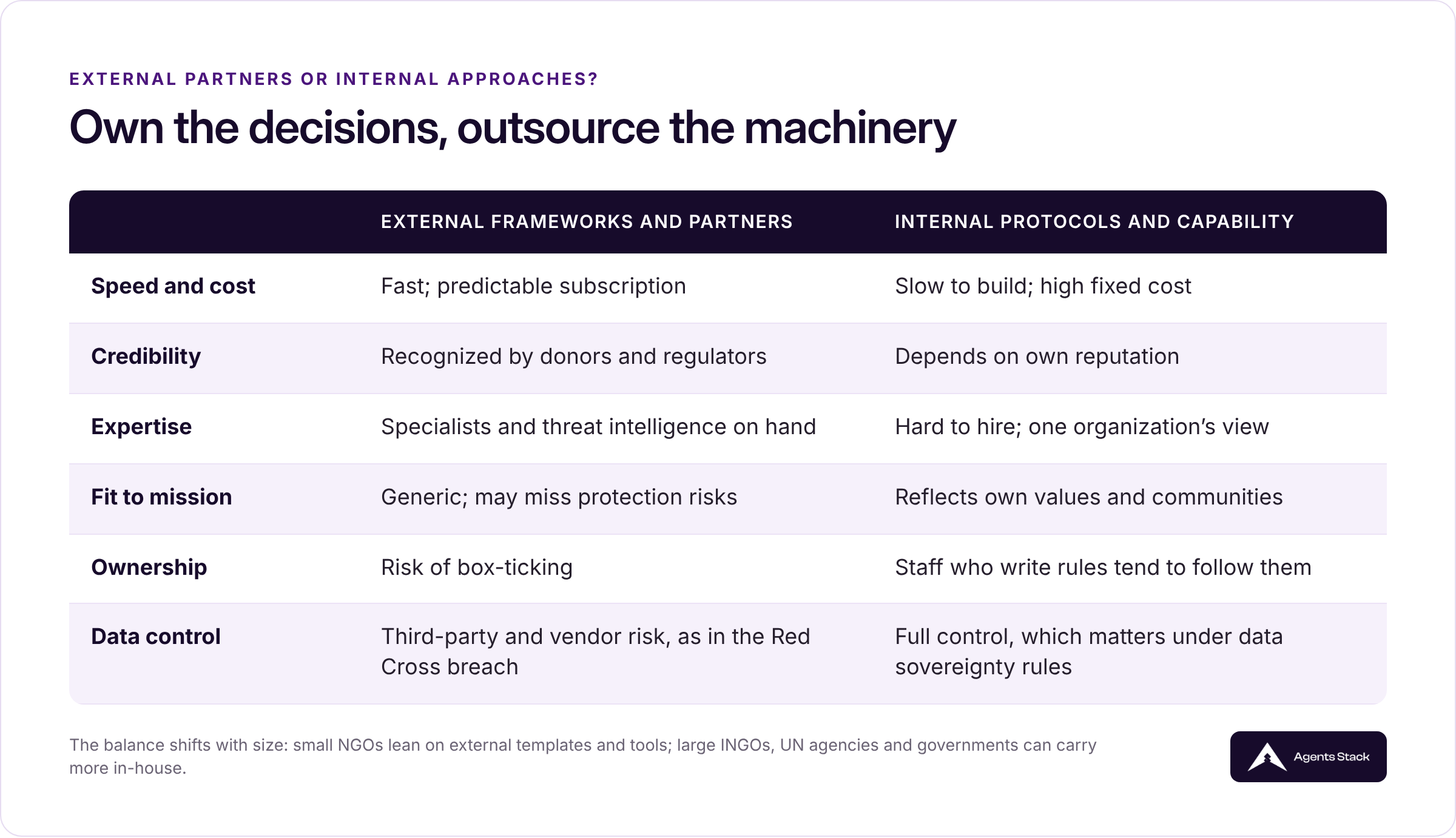
Both have real merits. The evidence favors a hybrid: own the decisions, outsource the machinery. Keep policy, risk appetite and accountability in-house; buy the tools, monitoring and threat intelligence.
Outsource the plumbing, never the conscience.
The balance shifts with size. Small NGOs should rely mostly on external templates, tools and volunteer support such as CyberPeace Builders (The Hague). Large INGOs, UN agencies and governments can carry more in-house, as Singapore shows.
Outside Europe, regulation is the weakest explanation for slow AI adoption, and capacity gaps are universal. The barriers that best explain the lag are willingness and security.
The willingness gap is psychological, a fear of replacement the evidence does not yet support, and political, rooted in donor and public trust. The security gap is real, but avoidance only hides AI use.
Both gaps can be closed with the right partners and governance. The organizations already doing so had the same technology as their peers, plus the willingness to try and the governance to do it safely.
The technology is ready. The excuses are running out. It is time to start imagining what is possible.
The hybrid model above starts with knowing what AI is already in use and setting the rules for it. The Agents Stack AI Governance and Assessment is a fixed-scope engagement that maps your AI estate, including shadow AI, classifies each use by risk, defines oversight for AI agents, and ties your policies to evidence you can show a board, a donor or a regulator. You keep the decisions and the findings.
[2] IBM, Cost of a Data Breach Report 2025, via Help Net Security
[3] McKinsey & Company, AI at work but not at scale (State of AI 2025)
[4] NonProfit PRO, Nonprofit AI adoption hits 92%, but only 7% see major impact
[5] On Think Tanks, State of the Sector Report 2025
[6] Public First for the Center for Data Innovation, Public Sector AI Adoption Index 2026, via ITIF
[7] Webiano, Every charity uses AI now and almost none are ready
[8] Neodata Group, McKinsey State of AI 2025
[9] Chronicle of Philanthropy, The nonprofit AI gap: bosses are bullish, staffs are wary
[10] Hogan Lovells, EU legislators agree to delay for high-risk AI rules
[11] Third Sector, Zoe Amar on the Charity Digital Skills Report 2025
[12] Baker McKenzie, Singapore governance framework for agentic AI launched
[14] The Star (Kenya), State tightens rules on AI use of Kenyans' data
[15] CASRAI, Brazil's PL 2338/2023 status
[17] Pew Research Center, U.S. workers are more worried than hopeful about future AI use in the workplace
[18] Noy and Zhang, Experimental evidence on the productivity effects of generative AI, Science
[19] Anthropic, The Anthropic Economic Index
[20] Fortune, If AI is roiling the job market, the data isn't showing it (Yale Budget Lab)
[21] Brynjolfsson, Chandar and Chen, Canaries in the coal mine?, Stanford
[22] Chronicle of Philanthropy, How do donors feel about AI?
[23] Kindsight, 2025 Donor Perceptions of AI Report
[24] PetaPixel, Amnesty deletes AI images after backlash
[25] IT Brief UK, UK public sector races ahead with AI as trust lags
[26] Microsoft, Digital Defense Report: new insights on nation-state attacks
[27] Al Jazeera, Cyberattack on ICRC exposes data on 515,000 vulnerable people
[28] NetHope, 2025 State of Humanitarian and Development Cybersecurity Report
[29] Northern Ireland Cyber Security Centre, Cyber Security Breaches Survey 2025 statistics
[30] Techstrong.ai, Shadow AI is the silent data risk taking over workplaces
[31] OWASP Top 10 for LLM Applications 2025, explainer via DEV Community
[32] CGNET, Trust under attack: AI deepfakes and nonprofit security
[33] AI4D, PROMPTS (Jacaranda Health)
[34] J-PAL, Machine learning and mobile phone data for social protection
[35] Civil Service World, DSIT says AI tool could free up 75,000 civil servant days a year