
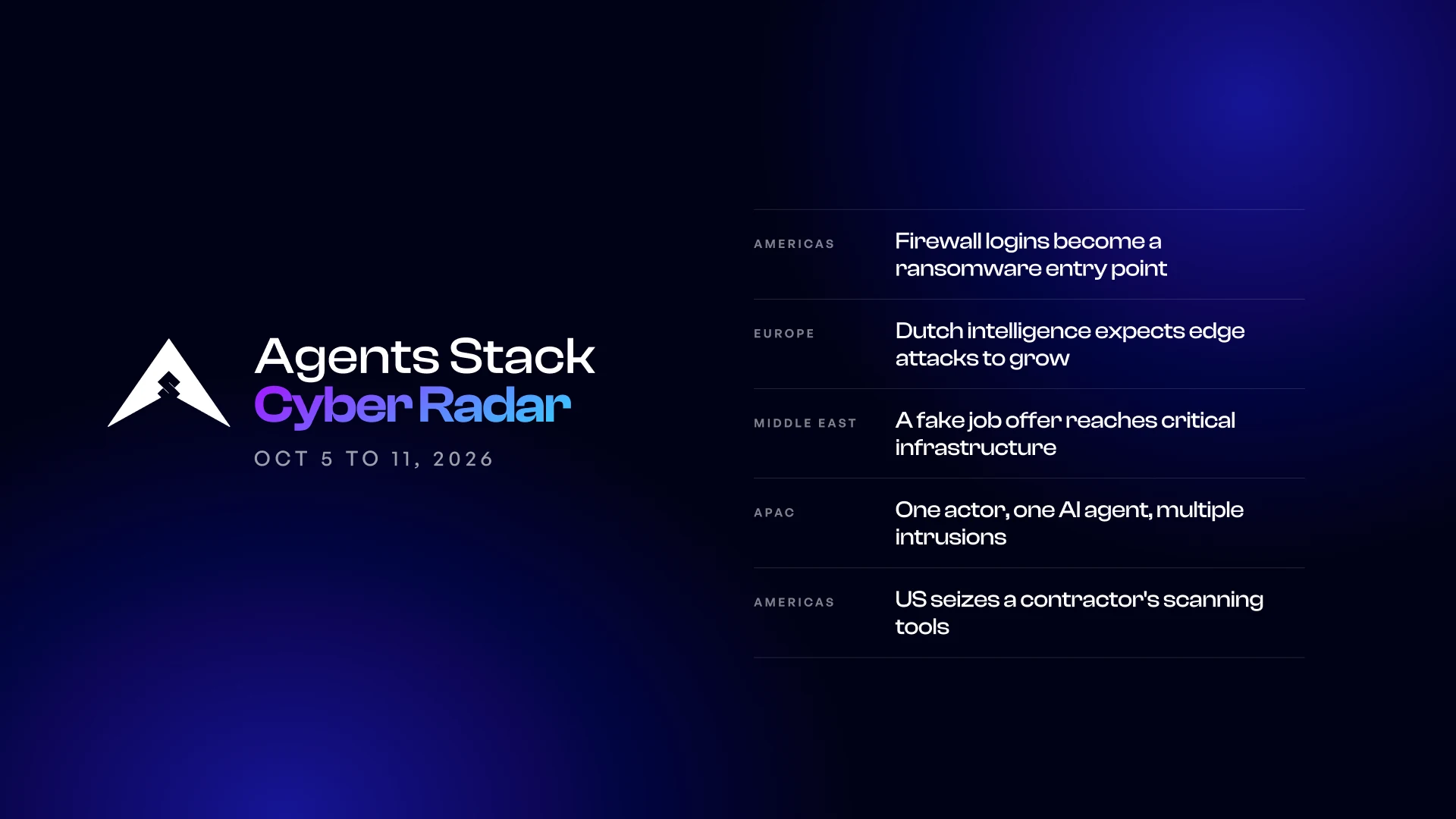
Nothing exotic happened this week, and that is the point. The FBI and Secret Service warned about firewall credentials, Dutch intelligence warned about edge devices, and the US and UK moved against a contractor that scans for exposed systems at scale. What is new is tempo: two of the five stories involve AI tooling that speeds up work attackers already knew how to do.
The FBI and US Secret Service issued a joint advisory on FortiBleed on October 6. They describe an active, global credential-compromise campaign against internet-facing Fortinet FortiGate firewalls and SSL VPN gateways. Attackers reuse leaked credentials and crack legacy password hashes at scale, then create new accounts to stay in. Some victims have been locked out of their own devices. The advisory says the chain has served as an entry point for ransomware affiliates, and it cites SOCRadar's count of more than 86,644 compromised devices across 194 countries. That number is the vendor's, relayed by the agencies.
What it changes: this is an identity problem living on a network device, which puts it in Identity Access and Fraud. A patch does not fix a reused password. The advisory's list is short and unglamorous: take administration off the internet, end active sessions, reset credentials, require phishing-resistant MFA, and compare the running configuration against a known good one. It lands hardest on firms with many branch sites and thin network teams.

The Dutch military and general intelligence services, MIVD and AIVD, published a cyber advisory on edge devices on October 7, working with the Dutch National Cyber Security Centre. They say Chinese hackers increasingly target the devices organizations use to connect to the internet, and that attacks through vulnerable edge devices are "set to grow strongly in the coming years." The services add that their recommendations also apply to attacks by other countries.
What it changes: this is a forecast from intelligence services, not an incident report. It tells boards that edge exposure is a standing condition to manage, which is a Threat Detection and SOC job more than a patching job. For US firms with EU operations, the read is practical. If you are in scope for NIS2, a national warning this specific is the kind of document a supervisor could reasonably expect you to have acted on. In NIST CSF 2.0 terms it sits in Identify and Detect: know every edge device you own, and watch them.

Palo Alto Networks Unit 42 published research on a campaign it calls Blinder Tunnel on October 6. Attackers posed as the Dubai Airports IT department, offered a development job, and sent a trojanized Visual Studio project as a coding challenge to a software engineer in Iraq's critical infrastructure sector. Unit 42 also reports targeting of telecommunications and aviation entities in Iraq, Israel and the UAE. It assesses with high confidence that the activity aligns with an Iranian-nexus threat. That assessment is Unit 42's. The researchers say they are not aware of any breach at Dubai Airports, whose name was borrowed for the lure, and that GitHub took down the infrastructure they identified.
What it changes: the way into critical infrastructure here was a developer's laptop and a job offer, not a control system. That makes it an OT and Critical Infrastructure story with a hiring-process fix. It lands on energy, aviation and telecom operators with engineering teams in the region, and on US firms that rely on regional contractors with code access.

CrowdStrike published a report on intrusions at South Korean financial organizations on October 7. The actor used ARTEX, an open-source agentic penetration testing tool, alongside large language models, in a campaign running from late September to early October. CrowdStrike has not tied the activity to a named adversary. It assesses with moderate confidence that the actor is likely a Chinese speaker and financially motivated. The breach details at individual banks come from industry reporting that CrowdStrike cites, and the number of affected organizations is unconfirmed. Some press coverage went further on attribution than the report does. We are staying with the report.
What it changes: CrowdStrike's point is that agentic tooling can let one financially motivated actor run several intrusions in a short window. For a Threat Detection and SOC function, that moves the pressure from spotting a clever technique to responding fast enough. It lands first on financial services, where customer-facing and staff-facing portals are many and exposed.

The US Department of Justice announced on October 8 the court-authorized seizure of two tools, Microscan and FishHub, and six domains. DOJ says the tools were operated and used by Integrity Technology Group, a China-based company with government contracts, and attributes the activity to Flax Typhoon actors. Scanning targets named by DOJ include a US power company in South Carolina, airports in Japan and Poland, and gas and power companies in Taiwan. The same day, the UK National Cyber Security Centre and partners from Australia, Canada, Japan, New Zealand, Spain and the US published an advisory saying actors enabled by the company use AI tools such as automated scanning, large botnets and manual exploitation to steal data.
What it changes: the advisory ships with indicators of compromise, so there is something to check today. Being scanned is the step before being breached, and it belongs with Threat Detection and SOC. It lands on energy, transport and universities.

Four of the five stories start at something that faces the internet: a firewall login, an edge device, a scanned perimeter, a bank portal. The fifth starts at a person who has access. None of them needs a new technique.
What differs is scale and speed. FortiBleed is credential reuse run as an industrial process. The NCSC advisory describes automated scanning. CrowdStrike documents an agentic pentest tool used in a live campaign. The Dutch services expect the volume to keep growing.
One caution. These are separate stories. No primary source links the FortiBleed campaign, the Dutch advisory and the Integrity Tech action to each other, and we are not linking them either. What they share is the exposure, not the actor. The practical read is that the internet-facing estate has become the most contested part of the enterprise, and the attacker's cost of working through it is falling.
Read together, the week describes a capability more than a control. A security function that wants to stay ahead of it needs to do five things continuously.
Keep a live inventory of everything that faces the internet, including the firewall management page someone exposed two years ago. Treat credentials on network devices like any other privileged identity, with rotation, MFA and session control. Detect configuration drift, because a new admin account on a firewall is the signal in the FortiBleed advisory. Turn government indicators into searches within hours, not at the next change window. Watch developer endpoints with the same care as servers.
None of this is hard once. All of it is hard every day, at 3 a.m., across every site. That is an operating problem, and it is why Agents Stack delivers it as a Managed Service: the work only pays off when it never stops.
Next week, watch three things. If FortiBleed lockouts are preceding ransomware at US public companies, some of that could surface in SEC Form 8-K Item 1.05 filings. South Korean regulators may publish their own findings on the bank intrusions, which would firm up what is still vendor and press reporting. And other European services may follow the Dutch lead on edge devices.


